Finding Belonging Across “The Counter” at TheaterWorks Hartford

Tina M. Manus
At a moment when almost the entirety of humankind is collectively captivated by Punch, the Japanese baby macaque whose tentative search for belonging has become a viral sensation, Meghan Kennedy’s The Counter offers a quieter, more intimate meditation on the same instinct. Now on stage at TheaterWorks Hartford, the play examines two human beings attempting their own fragile experiment in companionship—without the stuffed toy.
Directed by Rob Ruggiero, the production unfolds over 75 minutes, presenting what at first appears to be a simple theatrical premise: two ordinary people deciding, rationally, to form a connection across a diner counter. Yet Kennedy’s script quickly reveals itself to be less about romance than about something more primitive. What develops between the pair is not love in the conventional sense, but a kind of logically negotiated companionship—a platonic pact born of mutual loneliness and the simple human need to be truly seen by another person.
The play situates its characters in a small town somewhere in upstate New York, during the winter. Paul (Tim DeKay), a retired firefighter and former high school football star, is a familiar local face whose life has quietly fallen apart after a recent affair with a former high school classmate, Dr. Peg Bradley (Erika Rolfsrud). Unable to sleep and restless with the monotony of his days, he confesses that he wants to “be surprised.” DeKay gives a poignant performance as Paul. His towering frame contrasts strikingly with the fragile gaze of a man weighed down by grief, disappointment, and regret.
Across the counter, Katie (Justus Boulding) is a transplant from New York City who has taken refuge in the routines of diner work after experiencing a romantic rejection. For two years she has preserved a collection of voicemails from a man named Gil—the friend whose rejection prompted her to runaway from the city and into the ritual of pouring coffee each morning for the same small-town regulars. Boulding’s Katie is raw and sympathetic, a woman so wounded by loss and rejection that she seems emotionally paralyzed, unable to move on.
What emerges between Paul and Katie is less a conventional friendship than a deliberate act of mutual caretaking: an alliance between two people who recognize in one another the same unspoken need to be supported and seen.
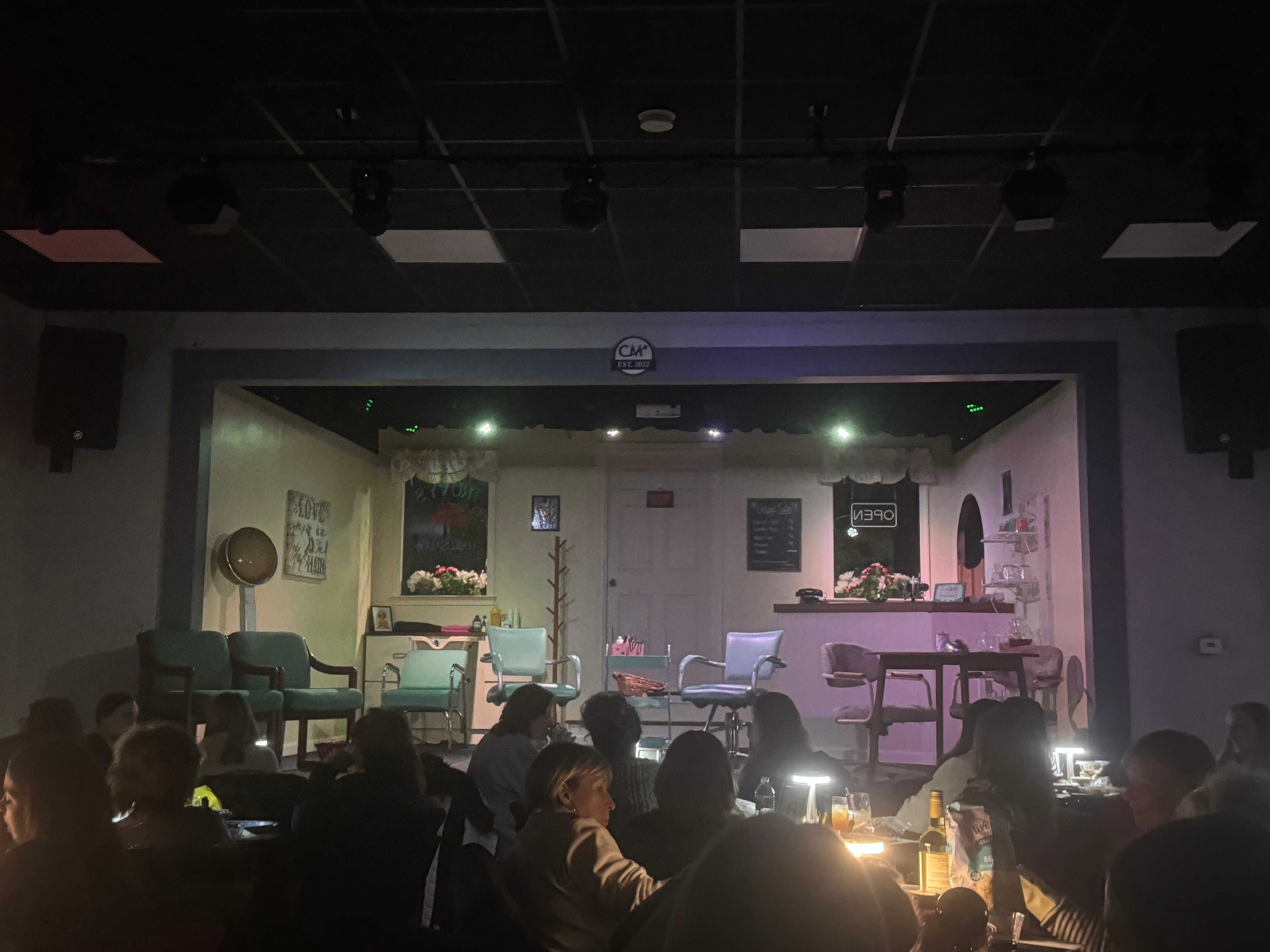
Tijana Bjelajac’s meticulously detailed set functions almost as a character in the play. The nostalgic diner, with its laminate counters, dial thermostat, and chrome stools, could exist in nearly any American town. Mint-green walls, sturdy ceramic mugs, and the familiar clatter of coffee pots create an environment of comforting ordinariness. Yet within this unremarkable space, Kennedy’s play unfolds a series of encounters that gradually feel anything but ordinary. The visual familiarity of the setting only heightens the emotional surprise when the characters begin to discover that connection may be preferable to isolation.
Ruggiero’s direction is particularly notable for the elegance with which it navigates a staging challenge inherent to the script. Much of the action of the play occurs across the diner counter, with the audience seated opposite of Paul. At first glance, the set suggests the possibility of an awkward theatrical dynamic—Katie’s back potentially turned toward the audience for extended stretches of time. Instead, Ruggiero transforms the limitation into a strength. Through precise blocking and an almost choreographic use of everyday props—coffee mugs, napkins, sugar dispensers—the stage remains visually alive. The director’s spatial awareness ensures that the audience never feels shut out of the exchange; rather, we are subtly invited into the rhythm of the diner itself. For directors, Ruggiero offers a masterclass in staging.
If audience response is any measure of resonance, The Counter has clearly struck a chord. Following previews, the production quickly sold out and was extended through March 22nd. At a sold-out March 1st matinee, the collective standing ovation was without hesitation.
Perhaps the appeal of Kennedy’s The Counter lies in the play’s gentle insistence on something many of us have nearly forgotten. In a post-pandemic world efficiently mediated by screens, artificial intelligence, and the convenience of digital life, Kennedy’s play reminds us that connection is rarely efficient and almost never convenient. It must be attempted, risked, and sometimes awkwardly negotiated—much like the hesitant social experiments of that now-famous baby macaque, Punch.
The Counter ultimately suggests that belonging, whether among primates or people, is not simply a biological instinct but a deliberate choice. And if Kennedy’s play has its way, audiences may leave the theatre momentarily inclined to lift their eyes from their devices, meet another person’s gaze, and rediscover the quiet courage it takes to reach across the counter.
The Counter is on stage now through March 22nd at TheaterWorks Hartford. Tickets can be purchased at the box office or online at https://twhartford.org/