Cabaret on Main Theater’s “Driving Miss Daisy” Illustrates the Quiet Power of True Friendship

Tina M. Manus
On its surface, Alfred Uhry’s Driving Miss Daisy is a simple story. It is a story about an elderly Jewish woman and the African-American chauffeur hired to drive her after she is no longer considered capable of driving herself. Using that storyline as a vehicle, Uhry exams of race, class, aging, independence, prejudice, and the complicated ways in which friendship develops.
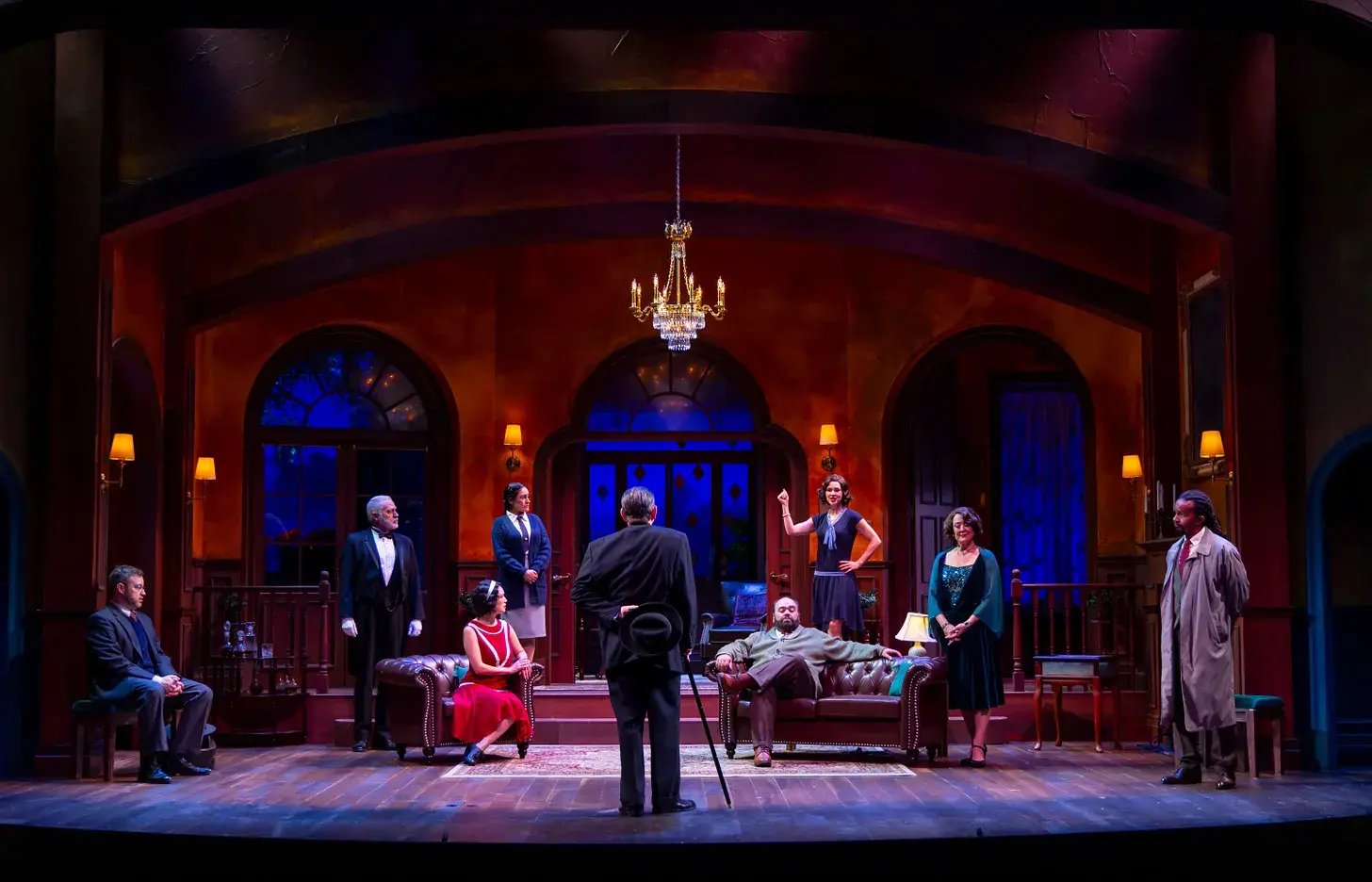
First produced Off-Broadway in 1987, Driving Miss Daisy won the Pulitzer Prize for Drama in 1988. Rather than relying on elaborate theatrical spectacle, Uhry places the emotional weight of the play almost entirely on its characters and their evolving relationship. Cabaret on Main Theater’s production, directed by Nick Rapuano, mirrors that sentiment with simple staging designed by Billy DiCrosta and Neil Fuentes that requires the characters to move to different locations on stage, without breaking the rhythm of the play with cumbersome set changes. This makes the stage version remarkably intimate: Daisy Werthan (Debi Freund), Hoke Colburn (Marvin “MJ” Jones), and Daisy’s son Boolie (Jamie Carson) are essentially the entire dramatic universe. There is nowhere for the characters—or the audience—to hide. Further, Rapuano’s staging includes beautiful tableaus on stage and seamless transitions that hold the audience’s attention and imagination throughout the performance.
The 1989 film adaptation, directed by Bruce Beresford, expands the theatrical world considerably. Jessica Tandy plays Daisy, Morgan Freeman portrays Hoke, and Dan Aykroyd plays Boolie. Tandy's performance earned her the Academy Award for Best Actress.
While the film version benefits from its ability to visualize the changing South around the characters. locations, cars, costumes, and historical events, the theatrical version can force us to remain in the room with them. On stage, the audience becomes an almost intimate observer of their relationship. The lack of cinematic distance makes every exchange more immediate. Cabaret on Main Theater with its immersive projection mapping seems the perfect location to stage this show to achieve this end, as the lighting design by Neil Fuentes, literally wraps around and embraces the audience holding them up close to the relational dynamics unfolding on stage.
Daisy enters the play as an intensely independent woman who does not want to surrender control of her life. When her son, Boolie hires Hoke as her chauffeur, she initially regards the arrangement as an unnecessary intrusion. Hoke, however, does not respond to Daisy’s resistance with hostility. His patience and understated humor gradually begin to disarm her.
What makes the relationship compelling theatrically is that Uhry does not transform Daisy and Hoke into instant friends. Their connection develops through conversations, arguments, silences, shared experiences, and the routines of everyday life, shared over decades. The audience watches a professional relationship slowly become a personal one.
The racial dynamics of the play are particularly important. Hoke is working within a society that routinely places limits on Black Americans, while Daisy is herself a Jewish woman living in a culture where antisemitism remains present. Uhry does not suggest that these experiences are identical; instead, he places two people who experience prejudice differently into a relationship that gradually forces each to see the other as an individual rather than as a social category.
This is especially effective because Daisy is not presented as a conveniently enlightened character. Her prejudices are real. At times, they are uncomfortable to watch. Yet, Uhry also gives her complexity, intelligence, humor, affection, and vulnerability. Hoke likewise avoids becoming merely a symbol of racial oppression. He possesses his own pride, intelligence, wit, and agency. The play's humanity comes from allowing both characters to be complicated.
For actors, this creates an unusually rich dramatic challenge—and all three rise to the challenge. Much of the play's conflict exists in the subtle spaces beneath and between the dialogue — a pause, a change in tone, or a character choosing not to respond can carry as much dramatic weight as an argument. The performances therefore depend heavily upon listening and timing. Freund, who started in last year’s Cabaret on Main smash hit, Misery, more than exceeds expectations. Her Daisy is both fiesty and measured, charming and insufferable—all at the same time. As the decades pass, Freund and Jones adjust their body language on stage to display familiarity and intimacy. This is complimented by the costume choices and superb wig designs for Daisy by Lily Parady. In addition, Carson also “grows into himself” throughout the course play, showing his own relational character evolutions with both Freund and Jones.
The play's greatest theatrical achievement may therefore be its restraint. There are no conventional heroes or villains driving the story forward. Instead, the drama emerges from time itself. Twenty-five years of history are compressed into a series of encounters, and the significance of those encounters becomes apparent only gradually.
The final stage of Daisy and Hoke's relationship is particularly affecting because the play has earned it. When Daisy, now living in a nursing home, recognizes Hoke as her best friend, the statement carries the weight of everything that preceded it. The woman who initially resisted his presence has come to depend upon the companionship she once rejected.
Driving Miss Daisy ultimately argues for the transformative power of human connection without pretending that friendship erases the social inequalities surrounding the characters. Its strength lies in its refusal to make reconciliation easy or sentimental. Daisy and Hoke do not solve the racial divisions of America. They simply learn, over the course of decades, to see one another.
That distinction is what gives the play its enduring theatrical power. Driving Miss Daisy reminds an audience that profound drama does not always require extraordinary events. Sometimes it exists in the quiet accumulation of ordinary moments—and in the surprising realization that the person who entered one's life as a stranger has become one of the people who matters most.
Cabaret on Main Theater’s production is not to be missed—and I recommend you come with plenty Kleenex. The preview I attended on Tuesday, September 15th had not one dry eye in the audience. I encourage everyone to attend Driving Miss Daisy and let its quiet wisdom linger. Because when the years have passed and the journey is nearly complete, what matters most is not what we owned, what we accomplished, or how much time we were given—but the life we lived and the relationships we made along the way.
Driving Miss Daisy runs from September 17th - October 4th at Cabaret on Main Theater. Tickets can be purchased online at https://www.cabaret-on-main.com